The real place
Giza stands on the west bank of the Nile, across the river from Cairo. On the plateau above the town are the three great pyramids, built for the kings Khufu, Khafre and Menkaure during Egypt's Fourth Dynasty, roughly 2600 to 2500 BC. The Great Pyramid of Khufu was the tallest structure in the world for thousands of years.
In front of them lies the Great Sphinx, carved from the bedrock and generally thought to show Khafre. Together with the wider necropolis of Memphis, the pyramid fields became a UNESCO World Heritage Site in 1979. Today the city has grown right up to the edge of the plateau, and Al-Haram Street, Pyramids Road, runs from the Nile out to the pyramids.
The Panorama, a ridge in the desert south-west of the plateau, is where many visitors go for the classic photograph of all three pyramids lined up together.
How the lap follows Giza
The lap is a loop through the desert and town south and east of the plateau, and it never enters the plateau itself: the pyramids, the smaller queens' pyramids and the tomb fields stay inside a keep-out zone at least 150 metres from the road. The start is on the Nile corniche, Nile Street, which then turns onto the desert road and climbs a ridge of dunes before running along Al-Haram Street and back through the village of Nazlet el-Samman.
Several things are pulled in for the race: the Nile is really about 8 kilometres east of the plateau (here about 300 metres), the Panorama ridge is shifted, and the Cairo skyline is brought in from 15 kilometres away. The Sphinx is seen across the village roofs on the last corner and never approached.
Racing tips
One lap of Pyramid Plateau Pass measures 1,648 metres, and a Grand Race is three laps. The road is between 14 and 18 metres wide, with two turns and four sweepers; the tightest corner has a radius of about 38 metres and the longest straight runs for about 242 metres. From its lowest to its highest point the road rises about 35 metres. There are five jumps, three boost pads and four rows of item boxes. The game rates it Medium.
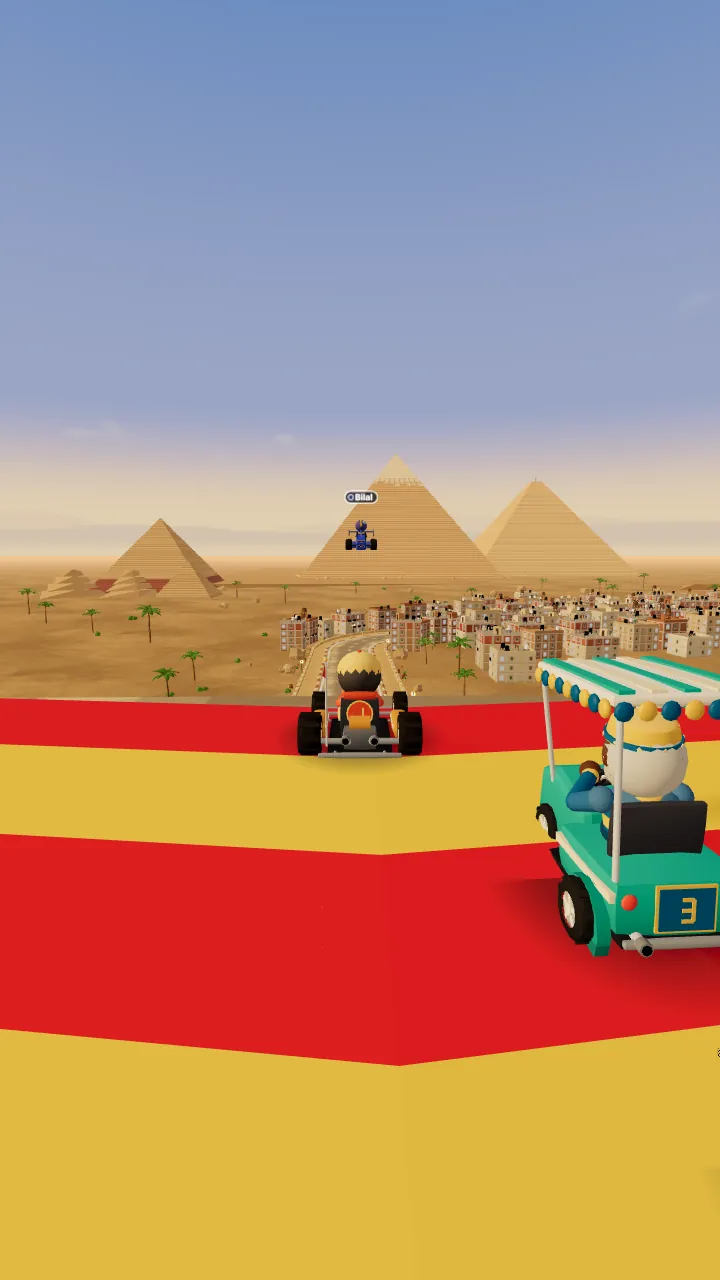
- The Panorama Leap is a 72-metre mega jump heading north off the ridge with all three pyramids ahead. The kart never passes over a pyramid; the landing is in the dunes well outside the site.
- A short sandstorm blows across the desert road on the climb, over a sand surface. Hold the centre of the road: sand only slows you away from the middle.
- There are no hairpins at Giza. Its corners are long sweepers, so the race is about carrying drift boosts from one bend into the next.
- The felucca cove splash early in the lap is a water stretch; you will skim it at full speed if you keep your foot down out of the first corner.
Lap at a glance
Where everything sits on the Pyramid Plateau Pass lap, as a share of the distance from the start line (1,648 m in all).
| Where | What |
|---|---|
| 3% | Item boxes |
| 4% | Boost pad |
| 5–10% | Water (skim above 18 m/s) |
| 18% | Item boxes |
| 26–32% | Sand (slower off the centre line) |
| 26–32% | Sandstorm |
| 29% | Jump: Dune Crest Hop (8 m gap) |
| 35% | Boost pad |
| 44–54% | Hero: Panorama Leap |
| 47% | Mega jump: Panorama Leap (72 m gap) |
| 65% | Boost pad (right side) |
| 69% | Jump: Wadi Hop (8 m gap) |
| 69% | Ring (fly through for a boost) |
| 71% | Item boxes |
| 83% | Jump: Nazlet Hop 1 (7 m gap) |
| 84% | Jump: Nazlet Hop 2 (7 m gap) |
| 88% | Item boxes |