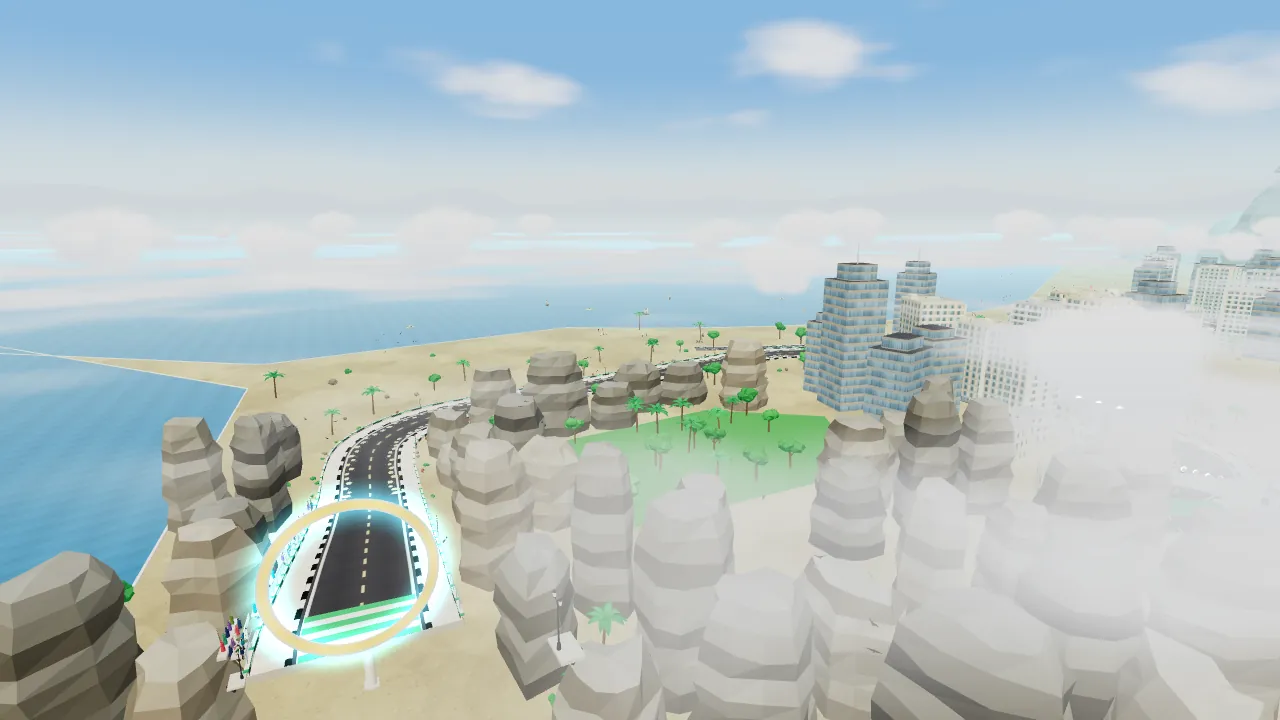
The real place
Rio de Janeiro sits between steep forested mountains and the Atlantic, at the mouth of Guanabara Bay. Its setting, 'between the mountain and the sea', was named a UNESCO World Heritage Site in 2012.
Copacabana beach runs for about 4 kilometres from Leme to the fort at its southern end, built in 1914. Beside it, Avenida Atlântica is lined with apartment towers, and its promenade is paved in black and white stones in a famous wave pattern; the landscape architect Roberto Burle Marx redesigned the promenade when the avenue was rebuilt and widened in 1970.
Sugarloaf Mountain rises 396 metres from a peninsula at the bay's mouth. Its cable car opened in 1912, the first in Brazil, running from the foot of Morro da Babilônia to Morro da Urca and then to the summit.
How the lap follows Rio
Avenida Atlântica is a real dual carriageway, and the lap races east on the inland side and home west along the beach side beside the wave promenade. At Leme it turns north through the Túnel Novo to Urca, where you ride a cable car up and glide back down the ridge to the beach.
This is a labelled composite: the real cable car does not go anywhere near Copacabana, which is about 2.5 kilometres away, and Corcovado is drawn 0.9 kilometres off instead of 5. Christ the Redeemer is a small, plain shape on the far skyline only, behind the kart during the hero, never a target. The beach kiosks carry no brands.
Racing tips
One lap of Copacabana Curve measures 1,738 metres, and a Grand Race is three laps. The road is between 13 and 18 metres wide, with one hairpin and five turns; the tightest corner has a radius of about 20 metres and the longest straight runs for about 324 metres. From its lowest to its highest point the road rises about 75 metres. There is one jump, three boost pads and four rows of item boxes. The game rates it Medium.
- The Sugarloaf Cable Car is a cable rail climbing to 75 metres; steering is locked. The glide that follows is a 96-metre mega jump with plenty of time for a trick.
- Late in the lap the road flicks through three banks alternating left and right at 22 degrees. Drift into the first and let the kart flow between them.
- The beach road home is about 300 metres of sand surface. Sand only slows you away from the centre line, so stay in the middle.
- The longest straight is about 320 metres: a good place to sit in a rival's slipstream for a second and slingshot past rather than pass straight away.
Lap at a glance
Where everything sits on the Copacabana Curve lap, as a share of the distance from the start line (1,738 m in all).
| Where | What |
|---|---|
| 1% | Boost pad |
| 6% | Item boxes |
| 14–18% | Tunnel |
| 15% | Boost pad |
| 20% | Item boxes |
| 23–35% | Cable rail: Sugarloaf Cable Car |
| 23–53% | Hero: Sugarloaf Cable Car and Glide |
| 42% | Mega jump: Sugarloaf Glide (96 m gap) |
| 45% | Ring (fly through for a boost) |
| 53–70% | Sand (slower off the centre line) |
| 72–73% | Banked road, 22° |
| 74–76% | Banked road, 22° |
| 75% | Item boxes |
| 76–78% | Banked road, 22° |
| 78% | Boost pad (left side) |
| 80% | Item boxes |
| 82–85% | Covered arcade |
| 86% | Ring (fly through for a boost) |